
Differentiation
One of the most important concepts you may have never heard of


When I get to know clients, one of the things I am most curious about is how they survived their childhoods. Even if someone who is going to therapy had a good childhood (some people do!), it’s never perfect, and they developed survival strategies for when they didn’t get the attention they may have wanted or needed. All parents are finite, right? Sometimes they get distracted, sometimes they are exhausted, sometimes they have too many balls in the air. This is reality.
But sometimes children have a crappy childhood and they end up needing to take care of themselves, emotionally or physically, because the caregivers are not doing their job. It may not always be intentional neglect, but it doesn’t matter to a little person who needs help and love. They have to find a way to cope.
These coping strategies follow us (ALL of us) into adulthood. It may look different than when you were little, but if you tried hard to get attention by being a good girl, you may be a people pleaser now, an uber-helpful friend or supermom; if you hid in the closet when the grownups were fighting, you may run away or shut down at any sign of conflict; if you developed a vivid fantasy life to cheer yourself up when your everyday life was miserable, you may stick your nose in a book, binge watch Netflix, or doomscroll when you feel empty or bored. Maybe you fought back or rebelled in order to keep from being swallowed up by people who didn’t want to let you be yourself, and now you are often angry or resentful.
These self-protective strategies aren’t BAD ideas. In fact, as a kid, you were brilliant coming up with ways to help yourself when nobody showed up for you. Even now, within reason, these things can be a helpful way to self-regulate (yes, even finding ways to blow off steam). BUT…if you rely on childish, immature strategies to carry the burdens of your adult life and relationships, well, you are going to end up frustrated when the people around you don’t appreciate your familiar go-to strategy for dealing with internal distress. Except maybe if you are a people pleaser, people will really appreciate your extra effort, but you will end up suffering when they don’t return the favor or burned out when you can’t keep all the balls in the air. If you are trying to be supermom, people pleasing ultimately backfires, because you just can’t please everybody.
So what does this have to do with my funny hand puppet show above?
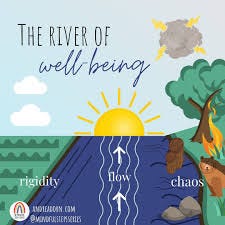
At the risk of oversimplifying this, let me just say I notice a general tendency to go from one extreme to the other in family systems. If the reins are too tight in one generation, the next generation tends to fling off restrictions to establish their individuality, unknowingly repeating patterns of generations and not being as unique as they intended. In my previous post, I mentioned the banks of Chaos and Rigidity that people end up clinging to as they float down the River of Life. The journey is much healthier if you maintain the tension between structure (rigidity in the extreme) and flexibility (chaos in the extreme).
In my pictures at the beginning of the post you see this illustrated.
The first picture, with my hands together, fingers intertwined, represents enmeshment, or rigidity. Families that subscribe to patriarchy, father ruling with an iron fist, explicit or implied (“You don’t want to find out what happens if you don’t comply!”), are obviously enmeshed. This can be on a spectrum from angry tyrants who verbally, emotionally, and even physically abuse their families, to general messaging that God expects you to submit to the ultimate authority of the father in order to receive blessing and avoid ultimate punishment. Whether is is obviously malignant or relatively benign, enmeshed families are not ideal. One person controlling everyone else leads to diminishing the personhood of the rest of the clan, leaving those with no voice, with no choice.
Enmeshment can be subtle, however, and it happens in families and marriages where nobody has ever heard of patriarchy. For example, when I hear stories of Grandpa and Grandma’s “great” marriage of 60 years, where they never had a fight and always did everything together, I suspect that someone had to become small in order to maintain this kind of “closeness.” It’s healthy to disagree sometimes, making the effort to explore each other’s differences and uniqueness rather than suppressing those individual qualities for the goal of keeping the peace. Maybe this worked for Grandpa and Grandma, but their progeny missed out on observing conflict done well.
The second picture above, hands in a fist, held apart, represents disengagement. In these types of relationships, people are usually very avoidant–they learned to protect themselves by keeping to themselves. This is where I need to distinguish between what Leslie Vernick calls “normal marriage problems” and abuse. Often it’s NOT a good idea to engage in conflict with an abusive partner, and survival means disengaging in some way. The women I help who have been abused often have tried the people pleasing/enmeshment route to survival, but when that just leads to getting trapped in a cycle of abuse, they need to learn to safely disengage.
However, some people use disengagement as a life strategy, never learning how to have intimate relationships with friends or romantic partners. They have built a protective wall around themselves (perhaps for very good reasons!) and they get trapped behind it, not able to trust anyone or trust themselves to be able to handle difficulties or disappointments. Again, Grandpa and Grandma may have modeled this, living parallel lives under the same roof for 60 years, never truly involved with one another’s lives in a meaningful way, digging a deeper rut every year, while everyone celebrates the “achievement” of staying married for so long. Such a shame.
So, like a pinball machine, people ping back and forth between these extremes of enmeshment (false closeness) or disengagement (avoidance of intimacy), generation after generation. What can be done?
The last picture above, hands together but fingers not entwined, represents differentiation. This is the idea that you can have two solid individual selves in a relationship, each person maintaining their individuality while staying connected to one another. Is this really possible? You bet!
When I showed this to clients, I would move my hands, knuckles together, up and down to represent friction in a relationship. For many people, friction (or conflict) is a reason to cling tighter through enmeshment or pull apart through disengagement. These responses are almost always learned behavior from childhood survival. Some people, who had especially difficult or confusing childhoods, may even swing between the two extremes, sometimes manifesting in personality disorders which idealize a partner then discard them when disagreements arise.
If you are familiar with attachment styles, these ways of interacting with others are sometimes called anxious (enmeshed), avoidant (disengaged), and disorganized (pinball machine), with secure attachment being represented by what I call differentiation (individuality and connection).
Now What Do I Do About It?
The first thing to do when you realize you are veering toward enmeshment or disengagement is to just notice it. Nobody is differentiated all the time. Name which end of the spectrum you seem to be living in at the moment. Become aware. Get curious, wondering about what is happening in your body…what distress are you feeling, what thoughts are you having? What behaviors are you engaging in when you think and feel this way? It’s beyond the scope of this post today, but in the future I will suggest some distress tolerance skills to try when you feel dysregulated.
After you get better at noticing and calming yourself, if you are in a relationship that is troubled with normal issues, then you might be able to initiate some conversations about this with your partner, too, inviting them with curiosity about their lived experience. If you are in an abusive situation, then you still want to do these things for yourself, but your safety and wellbeing are the priority, not trying to save the relationship.
Many people confuse the concept of differentiation with individuation. The latter is the important developmental process that begins in childhood when you hopefully learn who you are apart from the people around you, gaining the ability to express your own personality, pursue your own dreams, be your own person. Every child deserves to have this gift. In the system of patriarchy, this is discouraged, not only for the children but for wives, too. If you’re a Star Trek fan, think of the Borg. If you prefer Dr. Who, pick your villain: Cybermen or Daleks. The hive mind is the opposite of individuation and this makes differentiation very difficult.
Some dire situations, including abusive marriages and patriarchal cults (I plan to write more about Vision Forum) can narrow your choices, and if you have complex PTSD from years of surviving abuse–this includes neglect, as well as verbal, emotional, or physical and sexual abuse–or from imbibing false messaging in echo chambers year after year, it can be really hard to tell up from down, right from wrong, let alone feel you can confidently make any choice on your own. But you can.
Viktor Frankl, a psychiatrist who developed an existential school of psychology called Logotherapy, survived the Holocaust, but almost his entire family perished in Auschwitz, including his beloved wife. When he was in a concentration camp, he provided mental health support to other inmates to keep them from committing suicide. In his seminal work, Man’s Search for Meaning, Frankl wrote:
Everything can be taken from a man but one thing: the last of the human freedoms—to choose one’s attitude in any given set of circumstances, to choose one’s own way.
Biblical Patriarchy is NOT Biblical
Let’s not use this encouragement as an excuse to tell suffering people, “Just stop it!” or to, heaven forbid, withhold empathy from those who have been abused. For now, just be reminded that there is hope when you feel hopeless. You have strengths you may not realize and options you may not have yet discovered. I plan to share some ideas about that in the future. For now, you need information that will be a foundation on which to build healing.
The late Dr. David Schnarch was a sex therapist whose family systems view of relationships focused on the importance of differentiation in order to foster and maintain healthy relationships. He describes it this way:
One of the most important things in life is becoming a solid individual. And another important thing is to have meaningful relationships. Two of the most powerful human drives are our urge to control our own lives (autonomy), and our urge for relationship with others (attachment). One of the biggest tasks of adulthood is being able to balance these two urges, and one of the most common problems is having too much of one, and not enough of the other. People often feel claustrophobic or controlled in committed relationships, or feel like they can’t be their true self in their relationships, or feel like their sense of self is starting to disappear and they don’t know who they are any more. Others are constantly worried about “abandonment,” or “safety and security,” and constantly press their partner for “commitment,” and “unconditional love.”1
This concept of differentiation has been used by Christian therapists, as well, who recognize that the Bible itself suggests that this unity/diversity motif is God’s intention for relationships, especially within the church, where people have “many gifts” but exist in “one body” (e.g., Rom. 12:3-8; I Cor. 12:12-27).
Contrast this with what fringe pastor Doug Wilson, who inexplicably is garnering national attention promoting his patriarchal and Christian nationalist views, says about how husbands and wives should interact:
…wives need to be led with a firm hand. A wife will often test her husband in some area, and be deeply disappointed (and frustrated) if she wins. It is crucial that a husband give to his wife what the Bible says she needs, rather than what she says she needs.2
Listen, I used to believe this stuff and preach it, though women were technically not allowed to preach. I learned the hard way that this is not only a dead-end to healthy family life, but that it’s not God’s intention for men or women. I know this has been a heavy dose of psychoeducation, but I want to weave in some of my experiences in Patriarchyland with the lessons I learned when I got out. Some of you are still in it, some of it still lives in some of you. Detoxing is a long process. I see you and want to cheer you on.

See more here: https://www.crucible4points.com/crucible-four-points-balance/.
In Reforming Marriage, Canon Press, 1995.
Thanks for this! The visual hand thing is such a good example!